 AR
 DE
 FR
 IT
Why UK Energy Price Caps Trapped British Manufacturers
Introduction
Why UK Energy Price Caps Trapped British Manufacturers
How well-intentioned consumer protections left UK factories exposed to extreme volatility and high network costs.
UK energy price caps were designed to shield households, but they inadvertently trapped manufacturers in a cycle of volatility and high network costs. Discover how British factories face extreme electricity rates and actionable strategies to survive.
📊 Executive Summary
UK energy price caps protect residential consumers but leave industrial manufacturers exposed to extreme wholesale gas volatility and high network levies. This results in British factories facing some of the highest electricity rates in Europe, severely threatening the survival of energy-intensive sectors like steel and chemicals. Post-Brexit regulatory divergence and a heavy reliance on gas-fired power generation have exacerbated the issue, creating a structural disadvantage for UK industry. To survive, manufacturers must pivot towards long-term Power Purchase Agreements (PPAs), aggressive onsite energy efficiency upgrades, and strategic relocation to regions with better grid infrastructure. This guide dissects the mechanics of the price cap failure and provides a roadmap for industrial resilience.
The Structural Disadvantage of UK Manufacturing
While the broader European manufacturing energy cost crisis impacts the continent, the UK faces unique post-Brexit and policy-driven penalties.
Price caps shield homes, leaving industry to absorb wholesale spikes.
Heavy reliance on CCGT plants ties power prices to global LNG markets.
Disproportionate policy costs loaded onto industrial electricity bills.
Loss of seamless EU interconnector trading increases volatility.
UK ETS prices often diverge from EU ETS, adding compliance complexity.
Curtailment of renewables and constraint payments inflate system costs.
Bureaucratic friction prevents rapid relief for energy-intensive sectors.
High operational costs drive FDI toward EU and US markets.
The Illusion of the Price Cap
The UK energy price cap mechanism was fundamentally designed for the B2C retail market, creating a dangerous blind spot for industrial consumers.
The UK energy price cap mechanism was fundamentally designed for the B2C retail market, creating a dangerous blind spot for industrial consumers.
When the government introduced price caps to protect vulnerable households from soaring winter heating bills, policymakers failed to account for the structural realities of the B2B energy market. Unlike residential consumers, manufacturers cannot simply be shielded by a statutory ceiling without distorting the wholesale market. Instead, the policy inadvertently trapped factories in a cycle of extreme volatility. Suppliers, fearing regulatory intervention and margin compression, withdrew long-term fixed-price contracts from the commercial market. This left British factories exposed to the spot market, where prices fluctuate wildly based on global LNG shipments and wind generation deficits. The situation mirrors the broader European manufacturing energy cost crisis, yet the UK lacks the integrated cross-border buffers enjoyed by EU member states. Consequently, factory managers are forced to gamble their operating margins on daily wholesale swings, making financial planning nearly impossible and stifling capital investment in new machinery.
🎯 The price cap succeeded in protecting voters, but it effectively abandoned the industrial base to the mercy of unregulated wholesale markets.
The Gas Trap: Why UK Power Tracks LNG
The UK historical reliance on gas-fired generation means electricity prices closely follow wholesale gas prices, regardless of renewable growth.
The UK historical reliance on gas-fired generation means electricity prices closely follow wholesale gas prices, regardless of renewable growth.
Despite significant investments in offshore wind, the UK grid remains heavily dependent on Combined Cycle Gas Turbine (CCGT) plants to provide baseload and flexible backup power. This structural reliance means that the marginal price of electricity is almost always set by gas. When global LNG markets tighten due to geopolitical shocks or Asian demand spikes, UK industrial power bills surge in tandem. This dynamic is strikingly similar to Dutch gas dependency, where manufacturing pressure correlates directly with TTF gas hub pricing. However, the UK post-Brexit isolation from the EU internal energy market means it has fewer immediate avenues to import cheap surplus power during gas shortages. The result is a structural premium on every kilowatt-hour consumed by British industry, rendering domestic production uncompetitive against global rivals who benefit from subsidized or domestic energy sources.
🎯 Until the grid achieves true baseload decarbonization, UK manufacturers remain hostages to the global LNG shipping market.
Network Costs and Green Levies
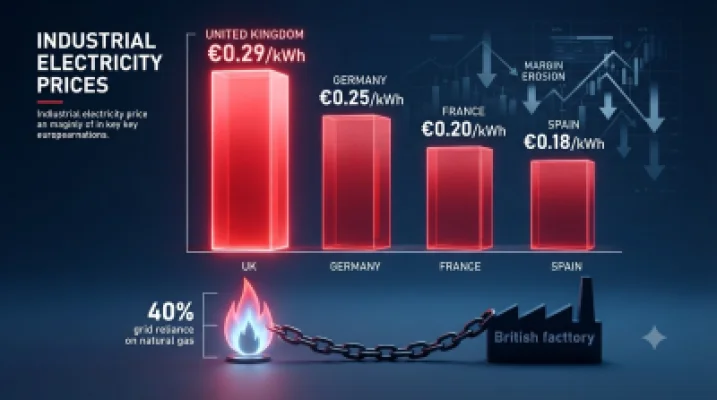
UK manufacturers pay some of the highest electricity prices in Europe due to disproportionate network costs and environmental levies.
UK manufacturers pay some of the highest electricity prices in Europe due to disproportionate network costs and environmental levies.
The composition of an industrial electricity bill in the UK reveals a punishing structural bias. While the wholesale generation cost is subject to global markets, the non-commodity costs—comprising network transmission charges, distribution fees, and green policy levies—are set domestically and fall heavily on medium-voltage industrial users. Unlike France, where French nuclear power historically subsidized industrial tariffs, or Germany, where German industrial electricity receives extensive grid fee exemptions, the UK spreads the cost of its renewable subsidies and grid upgrades across a smaller, less protected industrial base. This burden is comparable to the impact of Belgian energy taxes, which have severely hurt manufacturers margins. The sheer weight of these fixed, non-commodity costs means that even when wholesale gas prices drop, the final invoice for a UK factory remains stubbornly high, destroying any temporary relief provided by commodity market corrections.
🎯 The non-commodity burden acts as a permanent tax on UK manufacturing, immune to the fluctuations of the wholesale energy markets.
Post-Brexit Market Decoupling and Volatility
Exiting the EU Internal Energy Market severed the UK from seamless interconnector trading, amplifying price shocks.
Exiting the EU Internal Energy Market severed the UK from seamless interconnector trading, amplifying price shocks.
Before Brexit, the UK was fully integrated into the European day-ahead and intraday coupling mechanisms, allowing surplus power to flow efficiently across the Channel. The UK departure from these frameworks introduced friction, inefficiencies, and a loss of liquidity in the interconnector markets. This decoupling mirrors the wider post-Brexit trade friction that disrupted supply chains, but in the energy sector, it manifests as acute price volatility. When the wind stops blowing in the North Sea, the UK cannot instantly import cheap French surplus or Nordic hydropower without paying massive scarcity premiums. This isolation exacerbates the crisis as Brexit drained the UK manufacturing workforce in logistics and export-heavy sectors. The timeline below illustrates the steady degradation of the UK energy security and market efficiency since the transition period ended.
🎯 Market decoupling transformed the UK from an integrated European energy hub into an isolated island grid prone to severe scarcity pricing.
The Threat to Energy-Intensive Sectors
The compounding cost pressures are systematically hollowing out the UK most vulnerable industrial sectors.
The compounding cost pressures are systematically hollowing out the UK most vulnerable industrial sectors.
The survival of energy-intensive sectors like chemicals, glass, steel, and ceramics is directly threatened by the UK unique cost structure. These industries operate on razor-thin margins where electricity and gas constitute up to 40% of total operating expenses. Unlike the broader service economy, they cannot simply pass these costs onto consumers without losing global market share. The situation is reminiscent of the collapse of Italian industrial districts, where localized energy shocks led to widespread deindustrialization. Furthermore, the inability to attract capital for green transitions means these sectors are falling behind their European and American counterparts. The lack of skilled engineers to design and implement efficiency upgrades further compounds the issue, echoing the crisis where young Italians avoid factory jobs, leaving an aging workforce unable to innovate. Without immediate structural intervention, these foundational industries face permanent offshoring, compounding the issue of unfilled manufacturing jobs across the continent.
🎯 Without targeted structural relief, the UK risks losing its foundational heavy industries to global competitors with subsidized energy basins.
Onsite Renewables and Energy Efficiency
To survive, manufacturers are aggressively pursuing onsite generation and radical efficiency upgrades to bypass the grid.
To survive, manufacturers are aggressively pursuing onsite generation and radical efficiency upgrades to bypass the grid.
Faced with structural grid penalties, forward-thinking UK factories are taking energy security into their own hands. The goal is to reduce energy costs by decoupling operations from the volatile wholesale market and punitive network levies. Installing rooftop solar PV and behind-the-meter battery storage allows facilities to shave peak demand charges and generate zero-carbon power. However, the path to self-sufficiency is fraught with bureaucratic hurdles. Planning permission delays and the sheer cost of grid reinforcement often stall projects. This mirrors the challenges seen when analyzing how Spanish renewables haven't stabilized prices for SMEs due to grid access barriers. Despite these hurdles, the ROI on efficiency measures—such as high-efficiency compressors, LED lighting, and waste-heat recovery—has never been higher. The checklist below outlines the critical steps for industrial decarbonization and cost reduction.
🎯 Self-generation and radical efficiency are no longer optional ESG initiatives; they are fundamental survival mechanisms for UK industry.
Securing Stability via Corporate PPAs
Long-term Power Purchase Agreements offer a lifeline, providing price certainty in an otherwise chaotic market.
Long-term Power Purchase Agreements offer a lifeline, providing price certainty in an otherwise chaotic market.
Corporate Power Purchase Agreements (PPAs) have emerged as the premier financial instrument for UK manufacturers seeking to hedge against wholesale volatility. By contracting directly with renewable energy developers for 10 to 15 years, factories can lock in a fixed price for a significant portion of their load, effectively bypassing the short-term spot market. This strategy provides the financial predictability required to secure bank financing for other operational upgrades. However, PPAs are not without risks. They require substantial creditworthiness, and the intermittency of wind and solar means factories still need a grid backup or expensive battery storage to cover dunkelflaute periods. Furthermore, navigating the complex legal frameworks of PPA contracts requires specialized expertise, a resource often lacking in mid-sized firms struggling to compete for talent against the tech and finance sectors.
🎯 PPAs represent the most viable financial hedge for large manufacturers, though they demand rigorous credit management and backup planning.
Navigating Government Compensation Schemes
The UK government offers relief programs, but bureaucratic friction severely limits their effectiveness for the broader industrial base.
The UK government offers relief programs, but bureaucratic friction severely limits their effectiveness for the broader industrial base.
Recognizing the existential threat to its industrial base, the UK government has implemented various compensation mechanisms, such as the Energy Intensive Industries (EII) exemption and the Industrial Energy Transformation Fund (IETF). These schemes aim to rebate a portion of the renewable obligation certificates and network costs for qualifying entities. However, the reality of accessing these funds is starkly different from the policy intent. The application processes are notoriously complex, requiring extensive auditing and proof of electro-intensity that many diversified manufacturers cannot meet. This bureaucratic burden is akin to the compliance costs imposed by the Supply Chain Act, where administrative overhead deters participation. Furthermore, the funding tranches are often oversubscribed, leaving many viable projects unfunded. Manufacturers must employ dedicated grant writers or consultants just to navigate the labyrinth of Whitehall requirements, diverting resources from actual production.
🎯 Government relief exists on paper, but the administrative friction renders it inaccessible for the majority of mid-sized manufacturers in acute distress.
The Relocation Dilemma Within the UK
Some manufacturers are abandoning the congested South to relocate to regions with better grid capacity and renewable access.
Some manufacturers are abandoning the congested South to relocate to regions with better grid capacity and renewable access.
The geographic disparity in UK grid infrastructure is forcing a painful internal migration. Factories located in the South of England and the Midlands face severe grid constraints, exorbitant connection fees, and frequent curtailment issues. In contrast, regions in the North of England and Scotland benefit from proximity to offshore wind farms, lower land costs, and greater network headroom. This internal relocation is driven by the sheer necessity of securing affordable, reliable power. The dynamic echoes the UK industrial property shortage, where available manufacturing space with adequate power capacity is virtually non-existent in traditional hubs. While moving a factory is a massive capital undertaking, the long-term operational savings and access to green electrons make it a viable survival strategy for heavy industry. Finding adequate warehouse space and grid capacity in the South is becoming impossible, mirroring the Paris region where SMEs cannot find suitable industrial real estate.
🎯 Internal migration to the North and Scotland is becoming a mandatory strategy for energy-intensive firms seeking grid headroom and renewable baseloads.
A Survival Playbook for British Factories
Surviving the UK energy trap requires a radical departure from traditional procurement and passive consumption models.
Surviving the UK energy trap requires a radical departure from traditional procurement and passive consumption models.
The era of passively accepting utility bills and relying on government bailouts is over. UK manufacturers must treat energy as a critical, volatile raw material that requires active, sophisticated management. This means integrating energy procurement, onsite generation, and demand-side response into the core financial strategy of the business. The challenges are immense, compounded by parallel crises like the French anti-waste law compliance for exporters, and the broader European manufacturing energy cost crisis. However, factories that successfully pivot to flexible load management, secure long-term PPAs, and aggressively retrofit their facilities will emerge with a structural advantage over slower-moving competitors. The future belongs to the agile, the efficient, and the self-reliant.
🎯 Passive energy consumption is a liability; active, integrated energy management is the new prerequisite for industrial survival in the UK.
UK Policy Interventions for Industrial Relief
The UK government and regulatory bodies have launched targeted initiatives to mitigate the structural disadvantages facing domestic manufacturers.
Grants for capital investments in energy efficiency and deep decarbonization technologies.
Proposed lowering of the electro-intensity threshold to include more mid-sized manufacturers.
Ofgem initiative to clear the interconnection queue and prioritize viable industrial projects.
Why Domestic Relief Programs Fall Short
Despite significant funding, structural bureaucracy and grid limitations prevent rapid relief from reaching the factory floor.
⚠️ Multi-year application and approval cycles mean funds arrive too late to save factories facing immediate insolvency.
⚠️ Strict definitions of electro-intensive exclude diversified manufacturers who still suffer massive energy cost burdens.
⚠️ Physical supply chain shortages for transformers and high-voltage cables delay infrastructure upgrades by up to a decade.
Glossary of UK Energy Terms
Frequently Asked Questions
❓ Do UK energy price caps apply to manufacturing businesses?
No, the statutory energy price caps introduced by Ofgem apply exclusively to domestic residential consumers. Industrial and commercial manufacturers remain fully exposed to wholesale market volatility and supplier pricing strategies.
❓ Why is UK industrial electricity more expensive than in the EU?
UK manufacturers face higher costs due to a heavy reliance on gas-fired generation, disproportionate network and green levies, and post-Brexit decoupling from the EU integrated internal energy market.
❓ How can UK factories protect themselves from gas price spikes?
Factories can hedge against gas volatility by signing long-term Corporate Power Purchase Agreements (PPAs) with renewable developers, investing in behind-the-meter battery storage, and participating in Demand Side Response programs.
❓ What is the EII exemption scheme?
The Energy Intensive Industries (EII) scheme provides eligible manufacturing sectors with a partial exemption from the costs of funding renewable energy support schemes, reducing their overall electricity bill.
❓ Why are British steel and chemical plants closing?
Energy-intensive sectors are closing because electricity and gas constitute a massive portion of their operating costs. The UK structural energy premium makes them globally uncompetitive against subsidized foreign rivals.
❓ Can UK manufacturers generate their own power?
Yes, many factories are installing rooftop solar PV, wind turbines, and combined heat and power (CHP) plants. However, they still face significant bureaucratic hurdles regarding planning permission and grid connection approvals.
❓ How does Brexit affect UK energy costs?
Brexit removed the UK from the EU Internal Energy Market, reducing cross-border trading efficiency, increasing interconnector friction, and preventing the UK from seamlessly importing cheap surplus power during domestic shortages.
❓ Are there government grants for factory energy efficiency?
Yes, the Industrial Energy Transformation Fund (IETF) provides grants for deep decarbonization and efficiency upgrades, though the application process is highly complex and funding tranches are frequently oversubscribed.