
 AR
 DE
 FR
 IT
The EU Logistics Crisis: Port Congestion & Driver Shortage 2026
Introduction
The EU Logistics Crisis: Port Congestion & Driver Shortage 2026
Severe bottlenecks and labor deficits are paralyzing European manufacturing supply chains.
From gridlocked ports to a massive deficit of truck drivers, the European logistics network is failing manufacturers. This structural collapse forces companies to abandon fragile just-in-time models and rethink their entire supply chain architecture to survive.
📊 Executive Summary
The European logistics and supply chain crisis has evolved from a temporary pandemic shock into a permanent structural handicap for the manufacturing sector. Chronic port congestion at major hubs like Rotterdam and Hamburg, combined with a deficit of 400,000 professional truck drivers, has severed the reliable flow of components and finished goods. For manufacturers, this means production lines are frequently starved of inputs, while outbound shipments face unpredictable delays. The financial toll is immense: inventory holding costs have surged as companies are forced to abandon just-in-time methodologies in favor of expensive safety stock. Furthermore, post-Brexit friction and chronic underinvestment in rail freight alternatives leave supply chain managers with few domestic escape routes. To mitigate these compounding risks, forward-looking manufacturers are aggressively diversifying their supplier base, near-shoring critical component production, and investing in deep-tier supply chain visibility. This guide dissects the specific failure points across the EU transport network and provides actionable strategies to build operational resilience.
The Structural Collapse of the European Transport Network
Europe's logistics infrastructure, originally designed for seamless just-in-time manufacturing, is buckling under the weight of chronic underinvestment, labor shortages, and geopolitical friction. The physical movement of goods has become the primary bottleneck for industrial output. Manufacturers are no longer limited by their production capacity, but by their ability to receive raw materials and ship finished products. This systemic failure is not uniform; it manifests as maritime gridlock at northern ports, a severe lack of heavy goods vehicle drivers, and bureaucratic chokepoints at new customs borders. The result is a highly volatile operating environment where transport reliability has vanished, forcing factories to absorb massive inefficiencies and capital costs just to keep their assembly lines running, compounding high energy costs and scarce industrial real estate.
Major northern and southern ports lack the automated throughput capacity to handle modern mega-vessels efficiently.
An aging workforce and poor working conditions have created a massive structural deficit in road freight capacity.
New post-Brexit border regimes require extensive physical and digital checks, halting the free flow of components.
Southern European rail networks remain heavily biased toward passenger transit, starving freight of viable alternatives.
Unpredictable transit times force manufacturers to purchase and store excess safety stock, tying up vital cash flow.
The traditional lean inventory philosophy is mathematically incompatible with current European transit variances.
Global shipping alliances prioritize high-yield trans-Pacific routes, leaving European exporters with severe equipment deficits.
Manufacturers lack visibility beyond their tier-1 suppliers, making them vulnerable to hidden logistics failures deep in the chain.
A Systemic Paralysis: How Logistics Failures Choke Manufacturing
The physical movement of goods has become the primary bottleneck for European industrial output, overriding production capacity constraints.
Europe's manufacturing engine is stalling, not from a lack of orders, but from an inability to move physical goods reliably across the continent.
The contemporary European supply chain is experiencing a systemic paralysis that directly undermines the continent's manufacturing base. For decades, industrial strategy relied on the assumption of frictionless transport—components arriving exactly when needed, and finished goods departing immediately. That foundational assumption has collapsed. Today, factory managers spend more time expediting delayed shipments of raw materials than optimizing their actual production lines. The crisis is multifaceted, stemming from physical infrastructure limits, severe demographic shifts in the transport workforce, and newly erected bureaucratic walls. When a critical sub-assembly is stuck on a tarmac or sitting in a congested port yard, the entire assembly line halts. This cascading effect means that logistics failures are no longer just a procurement headache; they are a direct threat to top-line revenue and market share, effectively capping the growth potential of the European industrial sector.
🎯 Until the physical transport network is stabilized, manufacturing output will remain artificially suppressed by logistics bottlenecks.
Maritime Chokepoints: The 5-to-14 Day Delay at Major EU Ports
Europe's primary maritime gateways are operating beyond their designed throughput capacity, resulting in severe vessel and cargo dwell times.
The continent's maritime gateways are buckling under the pressure of ultra-large container vessels and inadequate landside clearance infrastructure.
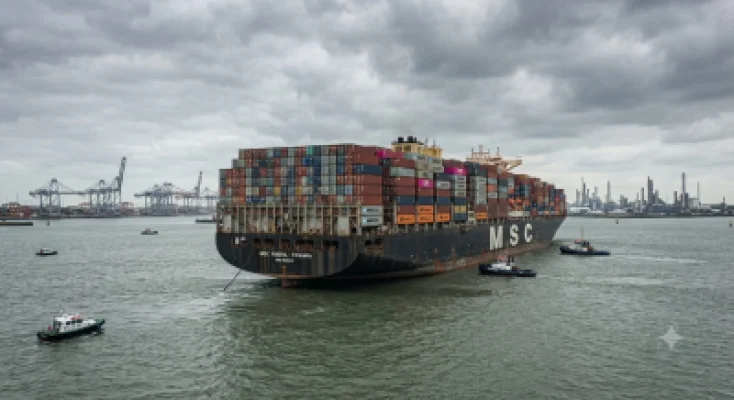
Europe relies heavily on a concentrated network of deep-sea ports to import raw materials and export finished manufactured goods. However, the major hubs are currently functioning as massive bottlenecks rather than efficient transfer points. The arrival of ultra-large container vessels (ULCVs) dumps thousands of TEUs onto the docks simultaneously, overwhelming the gantry cranes and the truck/rail interfaces required to clear the cargo. Consequently, vessels are forced to wait at anchor, and import containers sit in the yard for extended periods before being gated out. This maritime gridlock introduces a massive variance into supply chain planning, rendering published sailing schedules virtually meaningless for factory planners who depend on precise arrival windows, a situation worsened by frequent Hamburg port strikes and severe Italian port backlogs.
6.8 days average anchorage wait due to barge handling delays.
11.2 days average container yard dwell, exacerbated by rail strikes.
8.4 hours average truck turnaround time at deep-sea terminals.
92.5% occupancy rate, leaving zero margin for schedule disruptions.
🎯 Port congestion has transformed predictable maritime transit into a game of chance, forcing manufacturers to buffer against multi-week delays.
The Missing 400,000: Europe's Heavy Goods Vehicle Driver Deficit
An aging workforce and regulatory pressures have hollowed out the road freight sector, leaving hundreds of thousands of trucks parked.
The lifeblood of European manufacturing is road freight, but the sector is facing a catastrophic demographic collapse in its workforce.
Road transport accounts for the vast majority of intra-European freight movements, making the availability of qualified Heavy Goods Vehicle (HGV) drivers the single most critical variable in the supply chain. The industry is currently grappling with a structural deficit of 400,000 professional truck drivers across the bloc. This shortage is not a temporary market fluctuation; it is the result of an aging workforce retiring faster than new entrants can be trained, combined with the high cost of obtaining a commercial license and the demanding lifestyle the job requires. For manufacturers, this translates directly into rejected loads, exorbitant spot-market freight rates, and the inability to secure capacity for time-sensitive production components. The deficit severely limits the flexibility of the supply chain, as there is simply no surge capacity available when unexpected demand spikes occur.
🎯 The structural absence of hundreds of thousands of drivers permanently caps the velocity of the European inland supply chain.
The Dover Effect: How Post-Brexit Friction Rewired UK-EU Trade
New customs regimes and physical inspections have replaced frictionless trade with costly, time-consuming bureaucratic chokepoints.
The political reality of Brexit has manifested physically at the border, introducing severe friction into one of Europe's most vital manufacturing corridors.
The integration of UK and EU manufacturing, particularly in the automotive and aerospace sectors, vital for German auto parts, relied on components crossing the English Channel multiple times during the assembly process. The introduction of comprehensive customs declarations, rules of origin checks, and Post-Brexit border regimes has fundamentally altered this dynamic. What was once a seamless roll-on/roll-off operation now requires extensive pre-clearance documentation and is subject to physical holds. This bureaucratic friction disproportionately harms small and medium-sized manufacturers who lack the in-house customs brokerage teams to navigate the complex new compliance landscape, effectively acting as a non-tariff barrier that erodes margins and delays production schedules on both sides of the Channel, exacerbated by severe UK border delays.
🎯 The new border reality has permanently increased the cost and time required to move components between the UK and the EU.
The Missing Alternative: Rail Freight Neglect in Southern Europe
Chronic underinvestment in rail infrastructure leaves manufacturers in Southern Europe entirely dependent on an overburdened road network.
When road transport fails, manufacturers typically look to rail as a high-capacity alternative. In Southern Europe, that safety net does not exist.
A resilient supply chain requires modal redundancy—the ability to shift freight from road to rail when truck capacity dries up or fuel prices spike. However, in countries like Spain and Italy, decades of infrastructure investment have heavily favored high-speed passenger rail at the expense of freight corridors. The result is a rail network with inadequate loading gauges, insufficient passing loops for long freight trains, and poor last-mile connectivity to industrial parks. Manufacturers in the Iberian Peninsula are therefore trapped; they cannot use viable rail freight alternatives to bypass the truck driver shortage or to lower their carbon footprint, leaving them entirely exposed to the volatility of the road freight market and the geographical barrier of the Pyrenees.
Modal Imbalance: Spain's rail freight market share languishes at just 4.3% of total inland ton-kilometers, compared to the EU average of 17.6%, forcing total reliance on road transport.
Infrastructure Mismatch: The Iberian rail network was optimized for passenger speed, meaning standard intermodal freight wagons often require circuitous, slower routes to avoid tunnel height restrictions.
🎯 The lack of viable rail freight options in Southern Europe creates a dangerous single-point-of-failure for regional manufacturing hubs.
The Capital Trap: How Volatility Inflates Inventory and Kills Efficiency
Unpredictable transit times force manufacturers to tie up millions in excess safety stock, destroying working capital and warehouse efficiency.
The hidden cost of the logistics crisis isn't just the freight rate; it's the massive amount of working capital trapped in excess inventory.
When transit times become unpredictable, the mathematical models that govern lean manufacturing break down. To prevent line stoppages, procurement managers are forced to order larger batches earlier than necessary, transforming a just-in-time operation into a just-in-case warehouse. This shift has profound financial and operational implications. Capital that should be invested in R&D or new machinery is instead tied up in raw materials sitting on racks. Furthermore, warehouse space—already at a premium across Europe—is consumed by buffer stock, reducing the efficiency of the actual production flow and increasing the risk of obsolescence for engineered components.
Working Capital Drain
Manufacturers are holding an average of 27.4% more raw material inventory than in 2019, tying up critical cash flow in idle stock.
Warehouse Saturation
Buffer stock consumes valuable cubic volume, forcing companies to lease expensive off-site overflow storage or reject new production orders.
Obsolescence Risk
Engineering changes or demand shifts render hoarded components useless, leading to massive write-offs for highly specialized parts.
🎯 The logistics crisis has forced a costly regression from lean manufacturing back to high-inventory buffer models.
The Death of Lean: Why Just-in-Time is Failing European Factories
The extreme variance in modern European transit times has rendered traditional lean inventory models mathematically unviable.
The pursuit of zero inventory was the hallmark of European manufacturing excellence. Today, it is a primary cause of production stoppages.
The Just-in-Time (JIT) philosophy relies entirely on the premise of absolute transit reliability. If a truck is scheduled to arrive at 08:00, the component must be on the dock at 08:00. The current European logistics environment, characterized by port strikes, driver shortages, and border checks, makes this level of precision impossible. Manufacturers who stubbornly cling to lean inventory parameters are experiencing frequent stockouts and line-down events, which cost exponentially more than the carrying cost of extra inventory. Consequently, the industry is undergoing a painful paradigm shift, moving from a cost-minimization model to a resilience-maximization model.
🎯 Survival in the current logistics environment requires accepting higher carrying costs as the price of operational continuity.
The Container Squeeze: How Equipment Deficits Tripled Freight Costs
Global shipping alliances prioritize high-yield routes, leaving European manufacturers facing severe equipment shortages and exorbitant rates.
The physical steel box has become a scarce commodity, with global carriers dictating terms that heavily penalize European exporters.
The cost and availability of intermodal containers are dictated by global macroeconomic flows, not local European demand. When consumer demand spikes in North America, shipping alliances reposition their empty equipment to serve the lucrative trans-Pacific trade, leaving European exporters scrambling for boxes, driven by soaring container shipping costs. This structural imbalance, combined with the consolidation of the ocean carrier industry into a few massive alliances, has permanently reset the baseline for freight costs. Manufacturers can no longer budget based on historical averages; they must navigate a highly volatile spot market where equipment availability can vanish overnight.
⏱️ Timeline
🎯 The structural deficit of export containers forces European manufacturers to pay a permanent premium to access global markets.
Strategic Realignment: Near-Shoring and Diversification Tactics
Manufacturers are actively rewriting their sourcing strategies to shorten transit distances and eliminate single points of failure.
You cannot fix the European road network or print more truck drivers, but you can fundamentally alter where your components come from.
Faced with the permanent degradation of long-distance transport reliability, European manufacturers are executing a strategic realignment of their supply base. The goal is to shrink the physical distance between the component maker and the assembly plant, thereby reducing exposure to maritime delays, border checks, and driver shortages. This involves a deliberate shift away from hyper-concentrated, low-cost-region sourcing toward a diversified, regionalized model. While this may increase the baseline piece-part cost, it drastically reduces the total landed cost when factoring in the hidden expenses of expediting, safety stock, and line-down penalties.
📋 Checklist
🎯 Shrinking the supply chain footprint is the most effective defense against macro-level logistics failures.
The Resilience Playbook: Operational Strategies for 2026
Actionable protocols for supply chain managers to maintain production continuity despite the collapse of transit reliability.
Surviving the logistics crisis requires moving from reactive expediting to proactive, structural supply chain engineering.
Managing a manufacturing operation in the current environment requires a fundamental rewrite of the supply chain playbook. It is no longer sufficient to rely on the logistics department to find a truck when a shipment is late. Resilience must be engineered into the product design, the supplier contracts, and the daily production scheduling. The following protocols represent the operational shift required to maintain output and protect margins when the physical transport network is inherently unreliable.
🎯 Operational survival depends on treating logistics constraints as a fixed design parameter, not a temporary problem to be solved.
Institutional Interventions: The EU's Attempt to Fix the Network
The European Commission and national governments have launched several initiatives to alleviate the logistics bottleneck, focusing on digitalization and modal shift. However, the scale of the infrastructure deficit often outpaces these policy interventions.
Mandating standardized, interoperable digital customs and rail management systems across borders to reduce physical dwell times.
Subsidizing track access charges and prioritizing freight paths over passenger services on key North-South corridors.
National grants to offset the €5,000+ cost of commercial licensing and mandatory CPC training for new entrants.
Why Top-Down Logistics Fixes Fall Short
Despite heavy investment and regulatory pushes, the physical and demographic realities of the European transport network continue to overwhelm institutional solutions.
⚠️ Physical infrastructure limitations, such as tunnel heights and lack of passing loops in Southern Europe, cannot be solved by subsidies or scheduling priority.
⚠️ Subsidies address the cost of entry but fail to resolve the underlying lifestyle and working condition issues driving mass retirements from the profession.
⚠️ True interoperability requires legacy national rail and port systems to be entirely replaced, a process mired in local procurement disputes and technical debt.
Logistics and Supply Chain Glossary
Frequently Asked Questions
❓ Why are European ports experiencing such severe delays?
Major ports are overwhelmed by the simultaneous arrival of ultra-large container vessels and lack the automated landside infrastructure to clear the cargo quickly, leading to multi-day anchorage waits.
❓ How does the truck driver shortage affect manufacturing?
With 400,000 unfilled HGV roles, carriers lack the capacity to move components reliably, forcing factories to halt lines or pay exorbitant spot-market premiums to secure transport.
❓ Is Just-in-Time manufacturing still viable in Europe?
Traditional JIT is failing due to extreme transit variance. Most manufacturers are shifting to a just-in-case model, holding higher safety stock to prevent costly production stoppages.
❓ How has Brexit impacted EU-UK supply chains?
New customs declarations and physical border checks have added an average of 14.2 hours to transit times, destroying the frictionless flow required for integrated automotive and aerospace assembly.
❓ Why can't manufacturers just use rail instead of trucks?
In many regions, particularly Southern Europe, decades of underinvestment mean the rail network lacks the physical clearance, passing loops, and last-mile connections required for heavy freight.
❓ What is near-shoring and how does it help logistics?
Near-shoring involves sourcing components from geographically closer regions (like Eastern Europe or North Africa) to shorten transit distances and eliminate reliance on congested deep-sea ports.
❓ How are high container costs affecting European exports?
Global shipping alliances prioritize high-yield routes, leaving European exporters facing a structural equipment deficit and rates that remain over 200% higher than pre-2019 baselines.
❓ What is the best strategy to manage supply chain risk?
Manufacturers must invest in multi-tier visibility software, dual-source critical components, and dynamically adjust buffer stock based on real-time transit reliability data.